Showing posts with label Cuddle. Show all posts

Sunday, June 28, 2020

Anyone fancy a little Cuddle.. (report that is)

It's been about three weeks since the last layout progress report, so I thought it was about time for some kind of update from my workroom.
Last time I had turned the painting of the embossed stone styrene sheets over to my wife. She offered to do it so who was I to turn the offer of help down?
That left me at a loss of what to do for a while. With time on my hands, I turned to some micro layout design on my old blog Small Model Railway Layouts. One concept was so well received that I will have to build it. You can find preliminary concept work here.
All this has been keeping me busy, but it's not getting any work done on the layout. So I forced myself into action, and I started the ground cover process. The first stage involves covering the baseboard with lightweight sparkle, and for obvious reasons is known as the snowscape stage.
The snowscape phase.
Once that had dried. I set to and painted it with Woodlands Scenics ground colour. This is the same method as I've used on all my previous layouts.
Woodland Scenics ground colour down.
Then, while looking at the location of my model on Google earth I happened upon a photo of the actual beach in front of where the works would have been located.
The beach where the Cuddle works are sited
This helps immensely. Now I know what scenic treatment I have to do for the frontal area. To be honest, it looks an awful lot like Woodland Scenics Grey and Brown Talus.  I reckon I have some in stock somewhere too. Put down a base coat of grey paint and scatter Talus liberally atop of it, and I should be good to go.
In other news, I've found another suitable locomotive to operate the line. It's "Petrolia" of the Blakesley Hall Miniature railway, before its rebuild in 1910. A remarkable looking thing. Only two pictures are known to exist of it though, so some conjecture will be needed to produce a model. But in my early days in Gn15 I used to do that all the time.
I think Petrolia will look great running on the layout (Wikimedia image)

Sunday, April 19, 2020

The BIG news.


The development of Cuddle took a huge leap forward recently, with the news that the original Cuddle website has been recovered through the Internet Wayback Machine.
I must have been doing something wrong, because I couldn’t find anything. However, Chris Stockdale knew what to do and he found the original site archived. If you haven’t seen it already, here’s the link to “The Tramway to Cuddle”. It’s a delightful read to follow Andy’s thought processes, as he works through the history of his design, the operation of the layout, and the design of the buildings and stock.
For me, as someone who remembers the original postings on the site. It’s great to see this “old friend” again. But then again, it’s been so long since the site has been seen, it’s also like seeing it for the first time.
Some of the pictures aren’t there. But there is a small photo of the tiny retort house with a clock tower that he had found. As well as the panoramic photo of the cliffs behind Kimmeridge Bay with the original tramway course marked on it.
Then there’s the things I’d forgotten. Like the locomotives he had planned to build to operate the layout with, as well as his experiments with wagon loads.
Another thing I’d forgotten was that he had found the meaning behind the name of the location. Cuddle means “Yellow Ledge”, and doubtlessly refers to the limestone outcrops on the cliff face.
The “Yellow Ledges” are very apparent in this Geograph.org image
It’s a great boon to the project to have this at hand again. All micro layout designers could read and learn from Andys writings. It fires my enthusiasm for this project further. Hopefully, I can incorporate Andy’s visions into my interpretation of the project.


Wednesday, April 15, 2020

Cuddle Country.

Despite the humorous name, Cuddle really exists. It’s not a place as such, it’s the name of one of the hills that sit atop the the cliffs that form what is known as “The Jurassic Coast” World Heritage Site in southern England. You can see it named on this old Ordnance survey map under the “I M” of  KIMMERIDGE. You can also see the tramway that runs from Manfield Shaft down to a pier on the shore. These are the salient features that would have spurred Andy on his quest. My own research has discovered that the pier the tramway ran to was destroyed twice in big storms. One was built of iron, the other stone. It is a third, different stone pier that is marked on this map.
This late 1880’s  map of the area, shows Cuddle and the tramway
Geology is a complex thing, but basically, the underlying rocks of the area, known as “Kimmeridge clay” contains bands of bituminous shale, or shale oil. The strata comes up to the surface of the earth here in the Southwest of England, before diving down and reappearing in North East Lincolnshire, where the foundations of the Humber Bridge were sunk into it. The rock strata then dives down again to emerge a third time as the North Sea oil fields. 
As we know, these rocks contain oil, and the shale from here was used as far back as the 1600’s providing fire for glassmaking, and even further back in Roman times when they used the shale to boil seawater in the production of salt. Iron Age amulets have even been found made of the material.
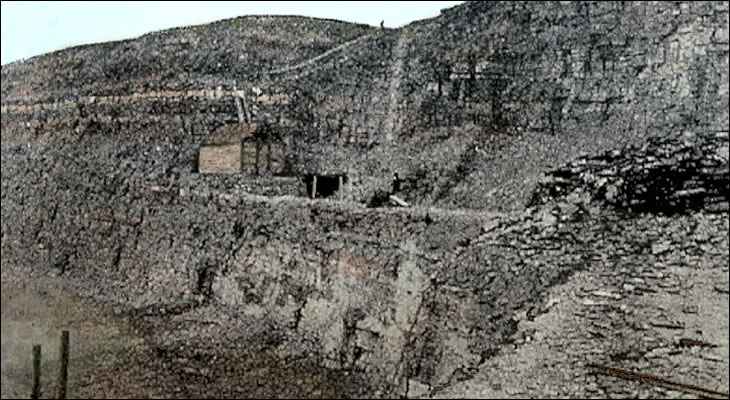
Serious working of the shale appears to have begun in the mid 1800’s. The shale oil was used to make products like varnish, pitch, naphtha, and dyes. The first tramway was built in 1848 and this is when the first adits were bored into the cliff faces. In some places works buildings appeared on the wave cut platforms on the cliff face. The most noted being that at a place called Clavell’s Hard. 
The adit and works at Clavell’s Hard in the 1890’s
That location certainly gives you ideas for a very spectacular model railway doesn’t it? 

Many companies tried to mine the shale as a profitable business, but all of them failed. 
The Mansfield mine shaft was sunk in 1883 and the tramway extended. Though I can find no information to suggest it was anything other than a horse worked line. The mine reached its maximum extent of 5,000 feet of tunnel in 1890 and things must have looked good. But before the end of the decade oil shale mining had ceased.
A survey in 1918 determined that the thinness of the seams and the high sulphur content of the shale meant that mining was always unprofitable and the owners were really on a hiding to nothing. 
The oil is there though, and should be able to be reached if the market conditions make it profitable. In fact, there has been a “nodding donkey” pump in the area tapped into the oil reservoirs since 1959.
It’s unlikely that shale oil mining will ever return to the area, but it has already had a fascinating history. 

Anyone fancy a little Cuddle.. (report that is)

It's been about three weeks since the last layout progress report, so I thought it was about time for some kind of update from my workro...